
The government has announced a tax cut from 2027. But once you measure against the inflation that has piled up over the years, it turns out the pre-Polski Ład system of 2021 was still more favourable in real terms.
A little-noticed feature of a progressive income tax is that if the thresholds aren’t adjusted for inflation each year, a quiet, continuous tax increase takes place. As wages rise in nominal terms, more and more people slip into the higher bracket – without a single word of the law being changed. In Poland, the 120,000 zł tax-base threshold for the 32% rate has stayed unchanged since 2022, while prices have climbed by more than 30% since. The phenomenon is known as bracket creep, or fiscal drag.
What the government announced
According to the Prime Minister’s Office statement of 19 August 2026, wages have risen by more than 30% since the coalition took office in October 2023, and the growing middle class bears the most acute tax burden. The change planned from 2027 introduces three brackets: the first threshold rises to 130,000 zł (keeping the 12% rate), a new intermediate 24% rate is added for a tax base of 130,000–150,000 zł, and the top 32% applies only above 150,000 zł. The ministry says 3.5 million taxpayers will benefit, the annual gain can reach 3,600 zł, and the share paying 32% will fall from a projected 14% to 7.2%. (Source: gov.pl)
First, the nominal picture
As a first step we worked purely with the nominal figures. Figure 1 shows the effective tax rate for the three regimes as a function of annual gross income. The effective rate here includes personal income tax plus the non-deductible health contribution; the thresholds apply to the tax base, which is roughly gross income minus the ~13.71% social-security (ZUS) contributions.
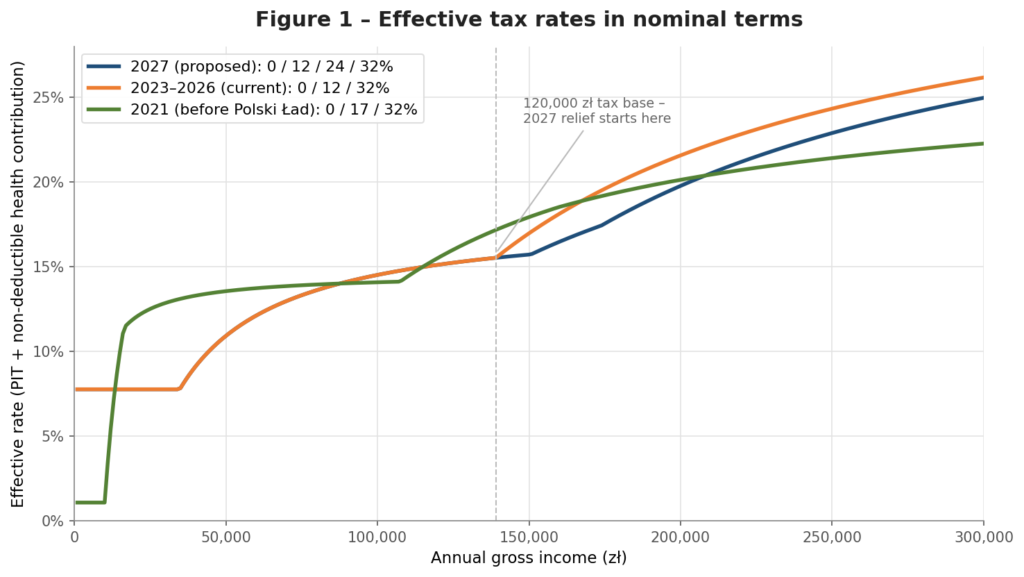
It is clear that above roughly 120,000 zł of annual tax base, the 2027 change does lower the burden relative to today: the blue (2027) curve slips below the orange (2023–2026) one. Anyone earning more than that is unambiguously better off in nominal terms. At lower incomes the two curves coincide – there the reform changes nothing.
But does it keep pace with inflation?
This is where the crux lies. The announced, nominal relief says little on its own if the purchasing power of money has meanwhile fallen sharply. So in the second chart we adjusted the income axis of the older scales for inflation – that is, expressed it in today’s (2026) money:
• the pre-Polski Ład state, 2021, from end-2021 (cumulative price level ×1.3637);
• the current state, 2023–2026, from end-2025 (×1.0272).
The 2027 scale is the reference and stays at today’s value.
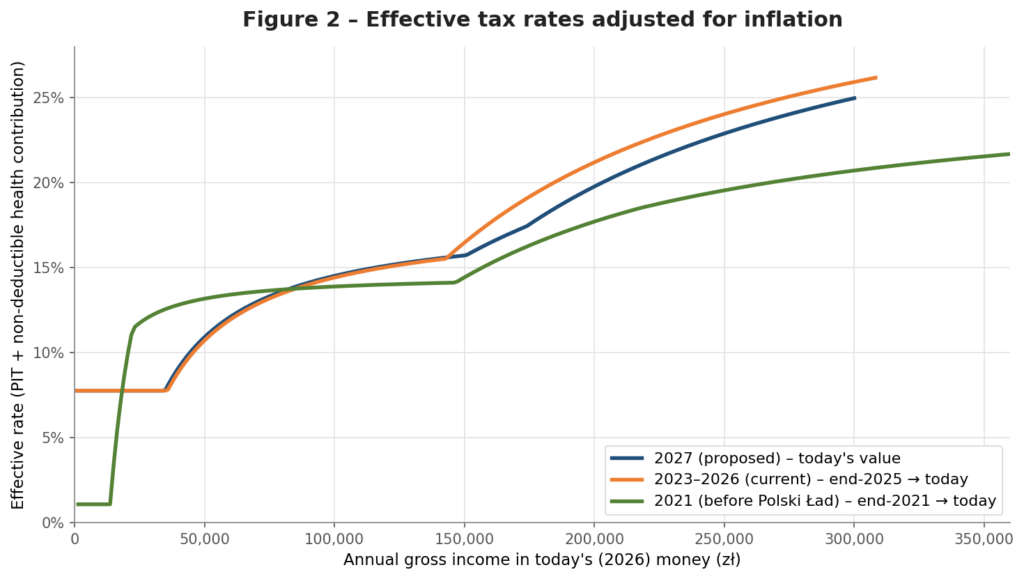
After the adjustment the picture reverses. In today’s money, at the same real income, the pre-2021 system has the lowest effective rate above roughly 100,000 zł of annual gross – even though in 2021 the tax-free amount was nominally lower, while the health contribution was still deductible back then. A few reference points, for annual gross income at today’s value:
| Annual gross (today’s value) | 2021 | 2023–2026 | 2027 |
|---|---|---|---|
| 100,000 zł | 13.9% | 14.4% | 14.5% |
| 150,000 zł | 14.4% | 16.5% | 15.7% |
| 200,000 zł | 17.7% | 21.2% | 19.8% |
| 300,000 zł | 20.7% | 25.9% | 25.0% |
Conclusion
The 2027 reform is undoubtedly relief relative to today in the middle and upper-middle income range. But once we set the yardstick at the pre-Polski Ład, 2021 real level, it turns out that under the rates in force until 2021 – together with the deductible health contribution and the nominally lower tax-free amount – we still paid a lower income tax in real terms. The current move therefore returns part of the bracket creep accumulated over several years, rather than being a genuine tax cut against the 2021 base.
Independent analyses back this up: the proposal compensates for only about 41% of the real value lost since the end of 2021. Had the 120,000 zł threshold been indexed to inflation year by year, it would stand at roughly 163,500 zł today – meaning the announced top threshold of 150,000 zł still falls short of merely keeping pace with inflation.
This is precisely the nature of unindexed thresholds: behind the visible, announced relief sits the invisible, continuous increase that inflation carries out. As long as the thresholds don’t follow the price level automatically, a “cut” can easily just slow the hidden hike rather than reverse it.
Who did Polski Ład really favour?
The second chart also reveals a rarely stated relationship. The 2022 overhaul – with the tax-free amount raised to 30,000 zł and a nominally lower rate (17→12%) – in real terms relieved mainly the lowest earners, because a high tax-free amount bites hardest precisely in the bottom bracket. Higher up, in the middle and upper-middle range, the frozen thresholds meant the real burden crept upward year after year. Many also read a political dimension into the reform: nominally higher allowances and lower rates were a striking relief for a broad, low-earning – and therefore, for the government of the day, important – group of voters, while the burden of the hidden, inflationary increase fell mostly on the middle class, only far less visibly.
The minimum wage is edging closer to the threshold
This shows well if we compare the 2021 and 2026 minimum wage. The minimum wage has risen by about 72% since 2021 (2,800 → 4,806 zł/month), while the 32% threshold has been frozen since 2022.
| 2021 | 2026 | |
|---|---|---|
| Minimum wage (gross / month) | 2,800 zł | 4,806 zł |
| Annual gross | 33,600 zł | 57,672 zł |
| ZUS contributions (13.71%) | ≈ 4,610 zł | ≈ 7,910 zł |
| Effective burden (PIT + health) | ≈ 13.0% | ≈ 11.9% |
| PIT + health per year | ≈ 4,380 zł | ≈ 6,860 zł |
| 32% threshold (tax base) | 85,528 zł | 120,000 zł |
| Minimum wage as % of threshold | ≈ 34% | ≈ 41% |
Two things stand out. First, because the minimum wage rises faster than the frozen threshold, the minimum-wage taxpayer now sits at 41% of the threshold instead of the earlier 34% – slowly but steadily approaching the next bracket (the 2027 threshold of 130,000 zł only eases this slightly). Second, the higher tax-free amount (30,000 zł) keeps the effective rate low at the minimum wage, but for that very reason it climbs more steeply between the minimum wage and the threshold: the 12% rate applies to a growing share of income, so the effective burden creeps up faster near the threshold than it did under the 2021 system with its low tax-free amount.
What to expect? The fate of the 2027 rules
Two practical questions will decide whether the announcement comes true.
By when must it be enacted? Under Polish practice, tax changes for the following year must take effect no later than 30 November (published with an adequate vacatio legis). To apply from 2027, the amendment must therefore be passed and published by roughly the end of November 2026. Since the announcement came only on 19 August 2026 – and so far it is only an intention, with no published bill – the legislative window is narrow; some presidential aides suggest it may already be “too late” for an overhaul of this scale.
Will the Sejm pass it? The proposal is a government one (Tusk–Domański), and thanks to the coalition’s Sejm majority the middle-class relief itself stands a good chance of passing; several sides in fact want the threshold raised (Polska 2050 earlier spoke of 140,000 zł, opposition voices even of 180,000 zł). The main risk lies in two places. First, the “other side” of the package – raising CIT to 22% for the largest firms, a higher solidarity levy and a lower lump-sum (ryczałt) limit – may spark disputes inside and outside the coalition; the Prime Minister himself called the move “not a tax cut but a rearrangement of taxes.” Second, a presidential veto: President Karol Nawrocki has recently vetoed or referred several tax laws to the Constitutional Tribunal, citing precisely an overly short vacatio legis and legislative haste. Overriding a veto requires a 3/5 majority in the Sejm, which the coalition lacks – so if the president blocks the package, its fate is in doubt. All of this plays out against a budget deficit of around 141 billion zł after July (51.8% of the annual plan), which further narrows the room for manoeuvre.
Methodology and sources
Effective rate = (PIT + non-deductible health contribution) / annual gross; for each regime the curves reflect the rules of that era (in 2021 including the then-deductible health contribution). Thresholds apply to the tax base (gross − about 13.71% ZUS contributions).
Inflation: GUS year-end (December/December) consumer price index – 2022: 16.6%, 2023: 6.2%, 2024: 4.7%, 2025: 2.4%, first half of 2026: ≈ 2.7%. Cumulative price level from end-2021 to mid-2026 ≈ ×1.3637 (in line with official data, +36.3%); from end-2025 to mid-2026 ≈ ×1.0272.
Minimum wage: 2021: 2,800 zł/month, 2026: 4,806 zł/month (Council of Ministers regulation, 11.09.2025). The source for the scale change and the legislative timetable is the Prime Minister’s Office statement (gov.pl) and the Polish economic and tax press. This article is informational and does not constitute tax advice.